
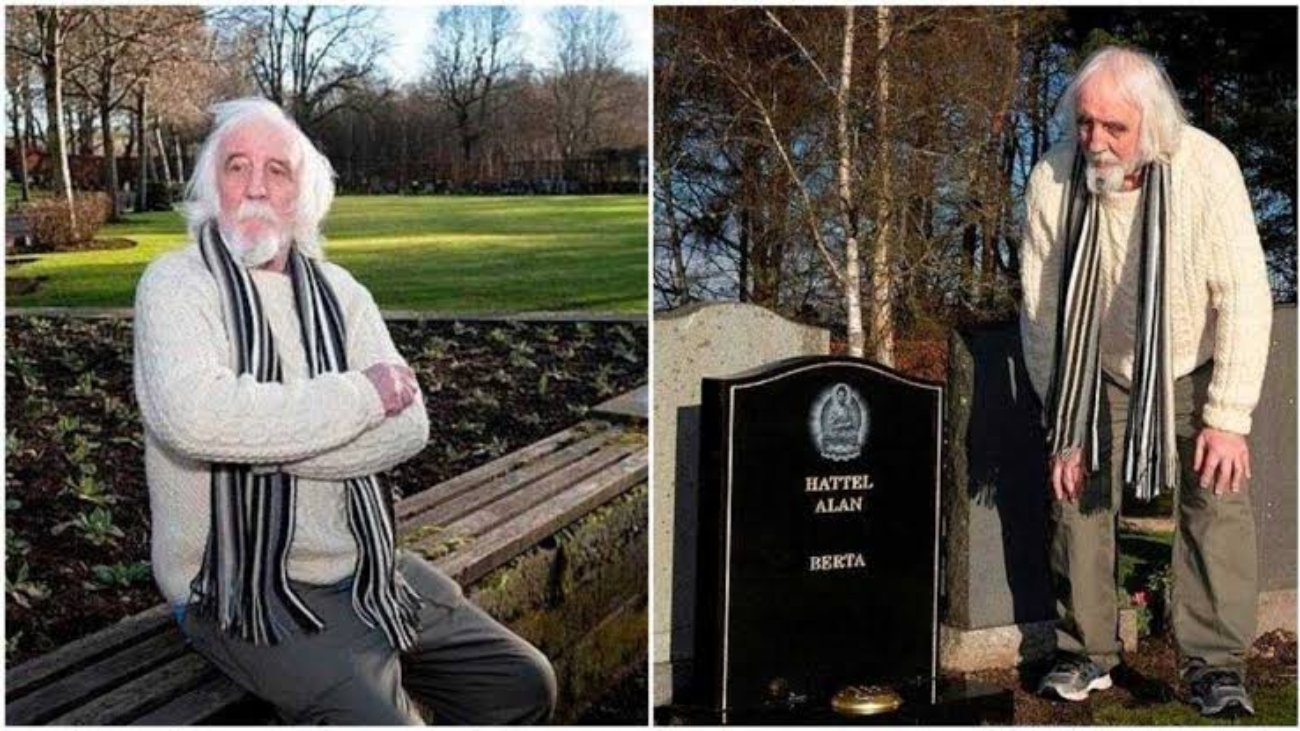
Imagine visiting a cemetery and finding your own name carved into a headstone — while you are still very much alive. That is exactly what happened to Alan Hattel, a retired welder from Scotland. Friends who came across the memorial assumed he had passed away. The story quickly caught media attention, not because Alan is a famous entertainer, but because the situation was so unusual and the family details behind it were genuinely complicated.
This article covers who Alan Hattel is, why his name sometimes appears online as “Hattel Alan,” the gravestone story, a long-unresolved divorce, and the family response that made the whole thing even more layered.
Alan Hattel or Hattel Alan — Clearing Up the Name Confusion
If you searched for “Hattel Alan” and ended up here, you are in the right place. The correct name order is Alan Hattel — Alan is his given name and Hattel is his surname. Some secondary biography-style websites list him as “Hattel Alan,” with the surname placed first, which is how many readers first encounter the name online.
This kind of reversal is common in genealogy databases and low-quality biography pages that format names surname-first, similar to how old index cards or records were sometimes organized. It does not mean “Hattel Alan” is a separate person or a stage name of any kind.
The Scottish Sun, which published the original news report about him, consistently uses the name “Alan Hattel.” A separate biography page on TheCityCeleb uses the reversed format but contains internally inconsistent details, so it should not be treated as a reliable source. If you see “Hattel Alan” elsewhere online, treat it as a name-order variation, not a different individual.
Who Alan Hattel Is
Alan Hattel is a retired welder from Forfar, a town in Scotland. He is not an actor, musician, or public figure in any conventional sense. He did not seek out media attention or build a public profile. He became the subject of a news story because of a very specific and unusual situation involving his former wife, a cemetery plot, and a marriage that turned out to be legally unfinished.
Beyond his occupation and location in Forfar, verified public information about his background is limited. Some biography pages online list a birth date, age, and net worth for him, but those details are inconsistent and lack reliable sourcing. It would not be accurate to repeat those figures as fact.
The honest description of Alan Hattel is this: a private Scottish man who became briefly newsworthy because of a story that was strange enough to be reported by a national newspaper.
The Gravestone That Started the Story
The story centers on a cemetery plot at Newmonthill Cemetery. Alan’s former wife, Berta, purchased a joint burial plot and had both their names placed on the memorial headstone. According to Alan, this happened without his knowledge or consent. He had no idea his name was on a grave marker until it had already been seen by others.
Friends who came across the headstone drew an obvious conclusion — they assumed Alan had died. Seeing a person’s name engraved on a gravestone is a reasonable reason to think that. Alan was, of course, still alive.
Berta’s reported explanation was practical rather than malicious. She said the arrangement was intended to spare their daughters, Collette and Lynn, from dealing with future funeral costs. The plot would already be paid for and designated, making things easier for the family later on.
It is worth being clear about what this story is and is not. This was not an official death declaration by any government body or authority. No one pronounced Alan legally dead. The situation arose from a private cemetery purchase that caused real confusion among people who saw the headstone. The reporting does not frame Berta’s decision as fraudulent or legally improper — it frames it as an unexpected and uncommunicated choice that had some awkward consequences.
The Separation, the Divorce That Never Happened, and What It Meant
The gravestone was unusual on its own. But the detail that added real weight to the story was the state of Alan and Berta’s marriage.
The two had been separated for approximately 26 years when the news report was published. That is a long time — over two decades of living completely separate lives. Most people would assume that a separation of that length would have ended in a finalized divorce long ago. In this case, it apparently had not.
Alan reportedly believed that the divorce had been completed. The reporting suggests it had not been legally finalized, which meant that at the time of the news story, Alan and Berta were still technically married in the eyes of the law.
This is a situation that is more common than many people realize. Living apart from a spouse for years — even decades — does not automatically dissolve a marriage. A legal divorce requires formal proceedings and documentation. Without that, the marriage remains on record regardless of how long the separation has lasted. Alan’s case is a clear illustration of why the difference between informal separation and legal divorce matters in practice.
The unfinished divorce also added another dimension to the cemetery arrangement. A joint burial plot between two people who were still legally married, even after 26 years apart, carried implications that went beyond just the headstone itself.
Alan’s Family and the Divided Response
Alan and Berta have two daughters together: Collette and Lynn. Their response to the situation reportedly fell on different sides.
Collette was quoted in a way that supported her mother’s position. She suggested that Alan had not considered the family’s feelings. That framing placed the criticism on Alan rather than on Berta’s decision to arrange the headstone without telling him.
The reporting does not provide a detailed account of Lynn’s position or of how the daughters were managing the wider family situation. It would not be fair to speculate beyond what was actually reported.
The report also noted that Alan had a girlfriend named Helen at the time, and that Helen was named as the executor of his will. This detail was included in the original news story and adds context to why the gravestone and the unresolved marriage were significant to him personally. His life had moved forward — he had a partner, plans, and a will in place — while the legal paperwork from his marriage to Berta had apparently never caught up.
Why This Story Gained Attention
Alan Hattel is not a celebrity in the way that term is usually applied. He has not appeared in films, released music, or cultivated a public following. The reason his name circulates online is because a Scottish newspaper picked up a story that was genuinely odd and relatable at the same time.
People respond to stories like this because they touch on things that feel familiar — family complications, paperwork left unfinished, communication that broke down somewhere along the way. The gravestone detail made it memorable. But the deeper story was really about two people who had been legally entangled for 26 years without fully resolving it.
If you are researching this topic through a genealogy platform like MyHeritage, it is worth knowing that those platforms pull from family trees contributed by individual users, historical newspaper archives, and public records. A name appearing in a genealogy search does not confirm a celebrity connection or guarantee the details are accurate. For Alan Hattel specifically, the most reliable source remains the original Scottish Sun report, which named him, identified his location, and provided the core details of the story.
For anyone interested in stories about ordinary people navigating unusual situations, Road of Business covers a range of topics that look at the real-world details behind headlines.
A Quick Summary of What We Know
- His correct name is Alan Hattel — “Hattel Alan” is a reversed name format used on some secondary websites.
- He is a retired welder from Forfar, Scotland.
- His former wife, Berta, arranged a joint cemetery plot at Newmonthill Cemetery and placed both their names on the headstone without telling him.
- Friends who saw the headstone believed Alan had died.
- Berta’s stated reason was to save their daughters future funeral costs.
- Alan and Berta had been separated for around 26 years, but the divorce reportedly was never legally finalized.
- They have two daughters, Collette and Lynn.
- Alan had a girlfriend named Helen, who was named in his will as executor.
Final Thoughts
Alan Hattel is not a household name, and he was not seeking fame. He is a retired Scottish welder whose family and legal situation happened to produce a story unusual enough to make the news. The gravestone incident was the hook, but the real substance of the story was the 26-year separation and the marriage that was never formally dissolved.
If you came looking for a conventional celebrity profile, this is not quite that. But if you wanted to understand who Alan Hattel actually is and what happened, the details above reflect what has been reliably reported. The rest — birth dates, net worth figures, or detailed personal histories found on low-quality biography pages — should be treated with caution, because the sourcing simply does not hold up.
Also Read: