
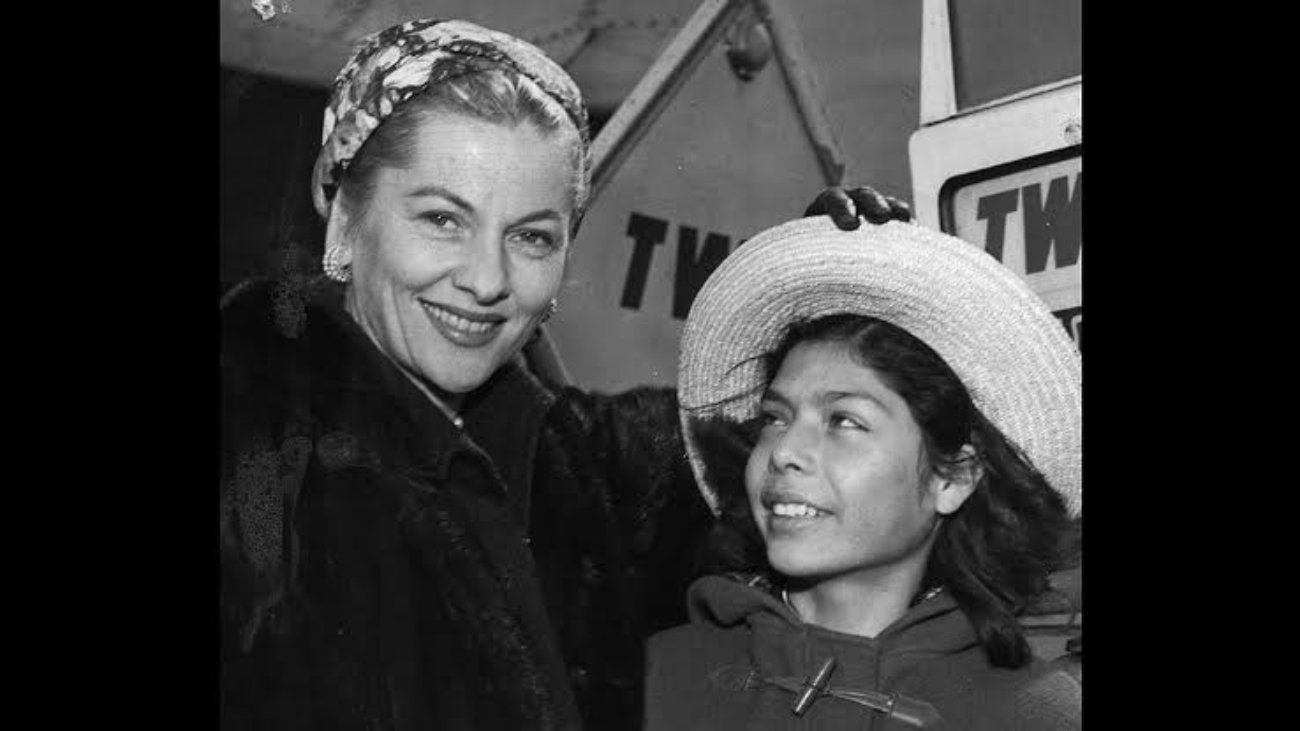
Most people who know Joan Fontaine remember her as the Oscar-winning star of Rebecca and Suspicion. But fewer know that she once brought a young Peruvian girl into her home and raised her as a daughter for nearly a decade.
That girl was Martita Pareja.
This article covers who Martita is, how she came into Fontaine’s life, what the historical record actually shows about the adoption, and what happened to their relationship over time. Where the record is thin or uncertain, this article says so clearly rather than filling in gaps with guesswork.
Who Martita Pareja Is
Martita Pareja is a Peruvian-born girl publicly identified as the child Joan Fontaine took into her care in the early 1950s. She is not an entertainer or public figure in her own right. Her name appears in the historical record almost entirely because of her connection to Fontaine.
Genealogy records, including entries on AncientFaces, list her birth date as November 3, 1946, in Peru. That date comes from secondary compiled sources, not independently verified civil records. It should be treated as reported rather than fully confirmed.
She is listed on genealogy sites and IMDb as Fontaine’s child or adopted daughter. These are entertainment and family-tree databases, not legal documents. The label “adopted daughter” reflects how Fontaine publicly described her, not necessarily what the courts recorded.
It is also worth noting that Martita Pareja is a distinct individual and should not be confused with other people who share the surname Pareja.
Joan Fontaine and the Machu Picchu Trip
To understand how Martita entered Fontaine’s life, it helps to know a little about who Joan Fontaine was.
Fontaine was one of classic Hollywood’s most celebrated actresses. She starred in Alfred Hitchcock’s Rebecca in 1940 and Suspicion in 1941, winning the Academy Award for Best Actress for the latter. She was also the younger sister of actress Olivia de Havilland, making the two of them one of the most discussed sibling pairs in Hollywood history.
According to reports supported by the Sydney Morning Herald, Fontaine met Martita during a trip to the Andes, including a visit to Machu Picchu. Martita’s father has been described in press coverage as a caretaker of the Machu Picchu ruins.
Fontaine brought Martita into her household around 1951 or 1952, when the child was approximately four or five years old. The exact year varies slightly across sources, so a precise date cannot be confirmed. What the sources do agree on is the general timeframe and the South American setting of their first meeting.
It is a striking detail — a Hollywood star visiting one of the world’s most iconic archaeological sites and returning home with a young girl she would go on to raise for years. Whatever the full story behind that decision, the connection between the two began in the mountains of Peru.
Adopted Daughter or Informal Arrangement — What the Record Actually Shows
This is the question readers most often ask, and it deserves a careful answer.
Fontaine publicly referred to Martita as her adopted daughter. Genealogy profiles and IMDb list her the same way. On the surface, the relationship looks like a straightforward adoption story.
But at least one secondary account — an obituary-style report from Outside the Beltway — states that the adoption was never formally completed in the United States. That would mean the arrangement functioned more like a long-term informal guardianship than a legally finalized adoption.
The honest answer is that the legal status is inconsistently described across available sources. No primary legal document has been cited in any of the public reporting reviewed for this article. Writers and readers should be careful not to call the adoption definitively complete or definitively incomplete, because neither claim is fully supported by the available record.
What can be said clearly is this: Martita was not Joan Fontaine’s biological daughter. Fontaine’s biological daughter was Deborah Dozier Potter, born from her marriage to producer William Dozier. The AncientFaces Joan Fontaine biography lists both Deborah Dozier and Martita as daughters, reflecting how Fontaine’s family is commonly described in compiled sources.
The relationship between Fontaine and Martita was real and lasted years. Whether it ever carried a formal legal title remains unclear based on publicly available information.
Life in the Fontaine Household and Their Later Separation
Martita reportedly lived with Fontaine for approximately a decade. That is a significant stretch of a child’s life, covering her early years through at least part of her adolescence.
One account, referenced in Sydney Morning Herald coverage of Fontaine’s life, describes how the two eventually separated. According to that account, Fontaine relocated to New York while Martita remained on a farm in Maine. The physical distance appears to have played a role in the end of their daily life together.
Public sources also describe a later estrangement in the relationship. The details behind that estrangement are not clearly or consistently explained in available reporting. Because the sources do not provide enough reliable information to explain what happened or why, it would not be accurate to assign blame or characterize the breakdown in any specific way.
Some secondary accounts use language suggesting Martita left the household on her own terms, but that detail appears in only one obituary-style source and lacks corroboration. It is mentioned here only to flag that it exists in the record, not to present it as established fact.
What the sources do support is that a relationship that began warmly, with Fontaine publicly claiming Martita as her daughter, became strained over time and eventually faded from public view.
What Happened to Martita After Fontaine
This is where the public record essentially goes quiet.
Martita Pareja did not become a public entertainer, a Hollywood figure, or a celebrity in any capacity. There is no reliable public information about her adult career, her family, her location, or her current status. Attempting to fill in those details would require speculation, and this article does not do that.
Joan Fontaine died on December 15, 2013, at age 96. Her passing prompted renewed coverage of her life, her famous feud with sister Olivia de Havilland, and her long career. Martita was mentioned in some of that coverage, which is part of why her name continues to appear in searches today.
Genealogy pages that list Martita’s name may show recent update dates, but those dates generally reflect when a webpage or database entry was revised or indexed — not new personal events in Martita’s life. They should not be read as evidence of recent news about her.
For readers interested in how public records and family-history databases handle complex family arrangements like this one, resources like Road of Business can offer broader context on how information is compiled and presented in secondary sources.
Why Genealogy Sites List Martita as Fontaine’s Daughter
It is worth briefly explaining why Martita’s name shows up on platforms like AncientFaces and IMDb.
These sites often compile information from obituaries, biographies, user-submitted family trees, and secondary press accounts. When a public figure like Joan Fontaine publicly called someone her daughter, that label tends to carry over into databases and profiles, regardless of the underlying legal status.
That is not necessarily wrong — it reflects how the relationship was publicly understood. But readers should know that a genealogy listing is not the same as a birth certificate, adoption decree, or court record. The entry reflects the relationship as reported, not as legally defined.
A Story That Raises More Questions Than It Answers
Martita Pareja’s story is unusual and, in many ways, incomplete. A young girl from the mountains of Peru ended up in the home of one of Hollywood’s biggest stars. She was raised there for years, publicly claimed as a daughter, and then the relationship quietly faded.
What is confirmed: Martita was a real person, born in Peru, who came into Joan Fontaine’s care in the early 1950s. Fontaine described her as her adopted daughter. The two lived together for roughly a decade before separating. A later estrangement is noted in public accounts.
What remains unclear: whether the adoption was ever legally finalized, exactly when and why the estrangement occurred, and what became of Martita in her adult life.
The gaps in the record are not unusual for someone who was never a public figure herself. Martita’s story surfaced alongside Fontaine’s, and when Fontaine’s public life ended, Martita’s trail in the public record largely ended with it.
She remains a quiet, largely unknown figure — remembered mainly as the Peruvian girl Joan Fontaine met at the foot of Machu Picchu and brought home to call her own.
Also Read: